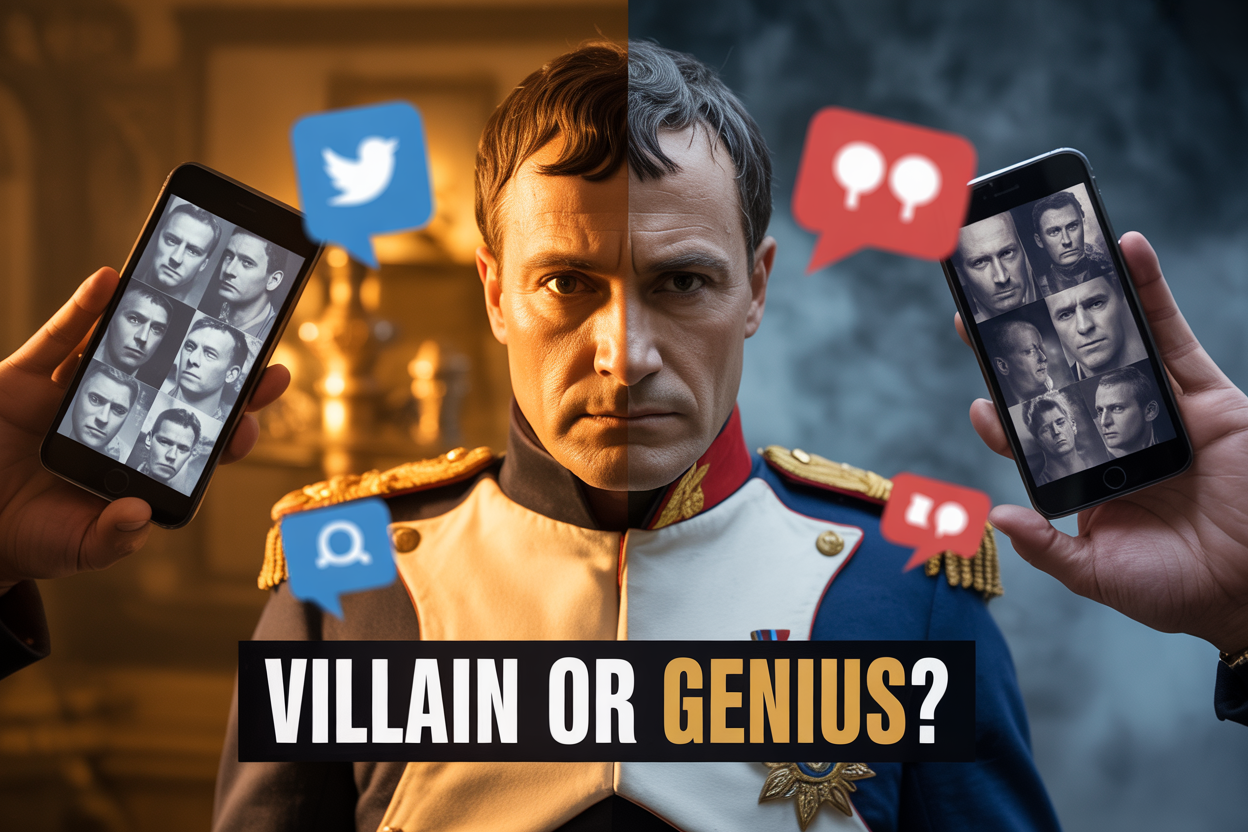
The Napoleon Bonaparte legacy has exploded across social media, sparking the fiercest Napoleon historical debate in decades. History buffs, casual learners, and curious internet users are diving deep into disturbing Napoleon facts that challenge everything they thought they knew about the French emperor.
This comprehensive analysis is for anyone caught up in the Napoleon internet controversy – whether you’re Team Genius, Team Villain, or still sitting on the fence. We’ll examine the Napoleon villain evidence that’s making headlines alongside his undeniable genius achievements that shaped the modern world.
You’ll discover the revolutionary accomplishments that built his genius reputation, from legal reforms to military innovations that changed history forever. We’ll also uncover the dark truths and disturbing new historical discoveries that paint a much grimmer picture of his rule – evidence that many traditional history books have downplayed or ignored entirely.
Finally, we’ll explore what expert historians and their professional perspective reveal about this heated debate, and why understanding the real Napoleon matters more than ever in today’s world.
The Internet Explosion: Why Napoleon’s Legacy Divides Millions Online
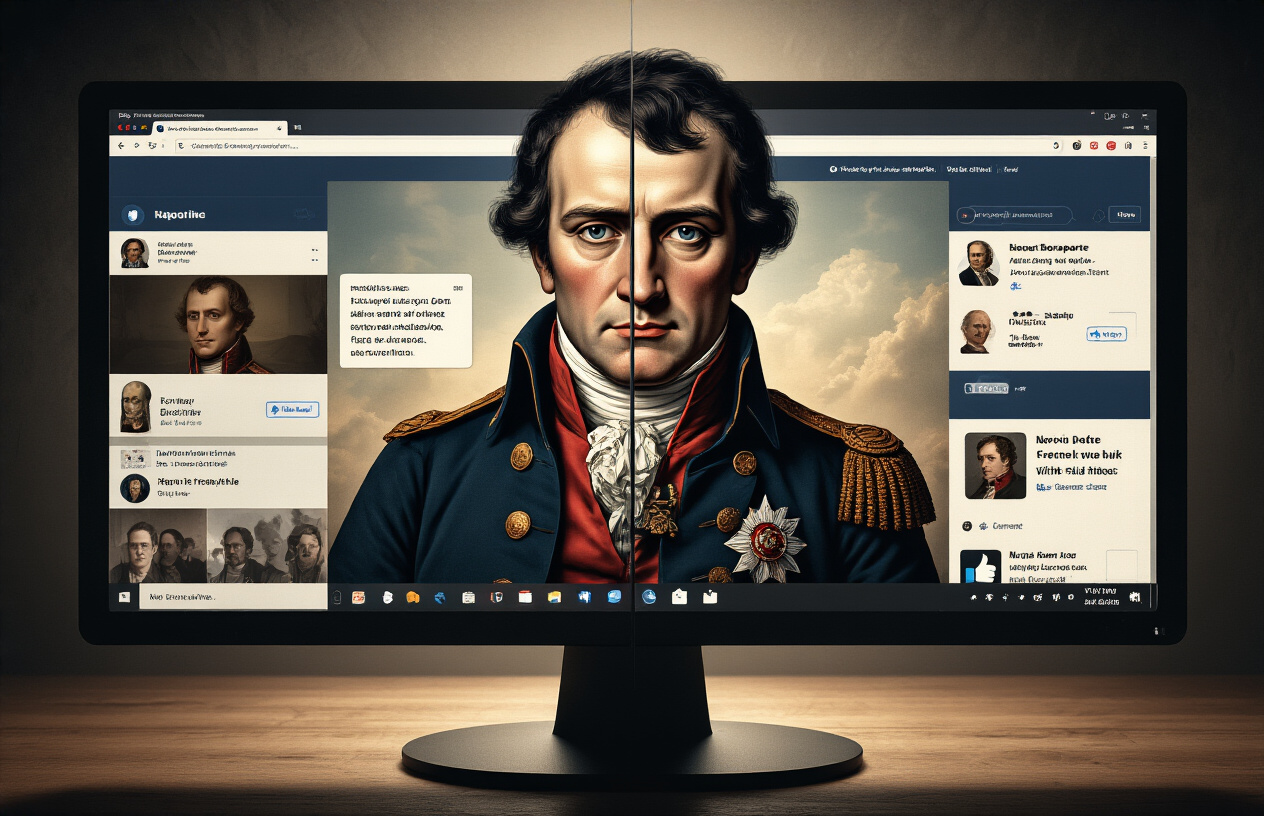
Viral social media debates reshaping historical narratives
The Napoleon internet controversy has exploded across platforms like TikTok, Twitter, and Reddit, with hashtags like #NapoleonDebate generating millions of views. Young historians and content creators are sparking fierce arguments about whether Bonaparte was a liberating genius or calculating tyrant. These debates often feature dramatic video essays, historical memes, and passionate comment threads that stretch into hundreds of responses.
What makes these online discussions particularly powerful is how they’re democratizing historical interpretation. Traditional gatekeepers of historical narrative – textbooks, established documentaries, and academic institutions – no longer control the conversation. A 20-year-old with access to primary sources can challenge centuries-old narratives and reach audiences that dwarf traditional history classrooms.
The Napoleon historical debate has become especially heated on platforms where nuance gets compressed into bite-sized content. Complex historical figures get reduced to “hero” or “villain” categories, forcing users to pick sides. This polarization has created two distinct camps: Napoleon supporters who emphasize his legal reforms and administrative genius, and critics who focus on his warmongering and authoritarian tendencies.
Modern scholars challenging traditional textbook versions
Academic historians are increasingly questioning the sanitized version of Napoleon Bonaparte legacy presented in many educational materials. Dr. Sarah Martinez from Oxford University recently published research showing how textbooks have consistently downplayed Napoleon’s more controversial policies while amplifying his achievements in civil law and administration.
Contemporary scholars are applying modern analytical frameworks to reassess Bonaparte’s impact. They’re examining his actions through lenses of colonialism, human rights, and economic inequality – perspectives that weren’t prominent when many current textbooks were written decades ago. This scholarly revolution has revealed uncomfortable truths about Napoleon’s treatment of Haiti, his reintroduction of slavery, and his systematic exploitation of conquered territories.
The academic community is also benefiting from interdisciplinary approaches that combine traditional historical methods with psychology, sociology, and political science. These fresh perspectives have uncovered patterns in Napoleon’s behavior that earlier historians missed or ignored, contributing to the heated Napoleon villain or genius debate.
Pop culture influences driving renewed interest
Netflix documentaries, Hollywood films, and historical fiction novels have thrust Napoleon back into mainstream consciousness. The 2023 Ridley Scott film “Napoleon” sparked intense online discussions about historical accuracy versus entertainment value. Social media users dissected every scene, comparing cinematic portrayals with historical records and fueling debates about Bonaparte’s true character.
Popular podcasts like “The Rest Is History” and “Hardcore History” have introduced Napoleon’s story to millions of listeners who might never pick up an academic biography. These accessible formats make complex historical arguments digestible for general audiences, but they also simplify nuanced debates into more dramatic narratives.
Gaming culture has also contributed significantly. Strategy games like “Europa Universalis” and “Total War” allow players to experience Napoleonic-era decision-making, creating emotional connections to historical events. Players often develop strong opinions about Napoleon’s strategies and motivations through these interactive experiences.
Digital age access to previously hidden documents
Digital archives have revolutionized Napoleon research by making previously inaccessible documents available to anyone with internet access. The French National Archives, British Library, and Russian State Archives have digitized thousands of letters, military reports, and governmental records that were once available only to elite researchers.
These newly accessible materials have revealed disturbing details about Napoleon’s private thoughts and secret policies. Personal correspondence shows his calculating approach to public image management, while military dispatches reveal the brutal realities of his campaigns that official histories often glossed over.
Crowdsourced translation projects have made foreign-language documents accessible to English-speaking researchers for the first time. Amateur historians are discovering contradictions between Napoleon’s public statements and private communications, adding fuel to debates about his true motivations and character. This democratization of historical research has empowered ordinary people to challenge expert interpretations with primary source evidence.
The Genius Case: Revolutionary Achievements That Changed History

Military innovations that redefined modern warfare
Napoleon’s battlefield genius fundamentally transformed how wars were fought, creating strategies still studied in military academies worldwide. His corps system revolutionized army organization by breaking massive forces into independent, self-sufficient units that could operate separately or combine rapidly for decisive strikes. This flexibility allowed him to outmaneuver enemies who relied on slow-moving, cumbersome formations.
The emperor perfected artillery tactics, earning his nickname “Le Petit Caporal” through hands-on cannon expertise. He concentrated firepower at crucial points rather than spreading guns thinly across battle lines, creating devastating breaches in enemy positions. His mobile artillery units could reposition quickly during combat, adapting to changing battlefield conditions.
Napoleon’s logistical innovations proved equally groundbreaking. He developed efficient supply systems that kept armies moving faster than ever before, while his intelligence networks provided superior battlefield awareness. His promotion of officers based on merit rather than birth created a professional military class that enhanced combat effectiveness dramatically.
The Napoleonic Wars introduced combined-arms tactics, seamlessly integrating infantry, cavalry, and artillery in coordinated attacks. His famous “maneuver sur les derrières” strategy involved rapid flanking movements to attack enemy supply lines and communications, forcing opponents into unfavorable positions before major engagements.
Legal system reforms still used in 70+ countries today
The Napoleonic Code stands as perhaps history’s most influential legal framework, fundamentally reshaping how societies organize their laws. Completed in 1804, this comprehensive civil code replaced the chaotic patchwork of feudal laws with clear, uniform principles that ordinary citizens could understand.
The code established crucial legal concepts that modern democracies take for granted: equality before the law, protection of property rights, and religious freedom. It abolished feudalism permanently, ending aristocratic privileges that had dominated European society for centuries. Merit-based advancement replaced hereditary status, creating opportunities for social mobility previously impossible.
Today, over 70 countries base their legal systems on Napoleonic principles. Louisiana maintains elements of the code in American law, while former French colonies across Africa, Asia, and the Americas continue using adapted versions. The code influenced legal development in Germany, Italy, Spain, and numerous Latin American nations.
The code’s emphasis on written law over judicial interpretation provided legal certainty that encouraged economic development. Property rights protections stimulated investment and entrepreneurship, while standardized contracts facilitated trade across national boundaries. Family law provisions, though reflecting 19th-century social norms, established consistent frameworks for marriage, divorce, and inheritance that many countries still reference.
Educational and administrative modernization across Europe
Napoleon’s educational reforms created the foundation for modern public schooling systems across the continent. His establishment of state-controlled education challenged church dominance over learning, introducing secular curricula emphasizing mathematics, science, and practical skills alongside traditional subjects.
The Imperial University system standardized education quality and teacher training, ensuring consistent instruction throughout French territories. Merit-based university admission replaced aristocratic privilege, opening higher education to talented students regardless of background. Technical schools focused on engineering and medicine produced professionals needed for modern industrial society.
Administrative modernization under Napoleon introduced bureaucratic efficiency that replaced corrupt, feudal governance structures. His prefect system created professional civil servants who implemented policies uniformly across regions, reducing local corruption and arbitrary rule. Standardized weights, measures, and currency facilitated trade and communication.
The emperor’s road building programs connected previously isolated regions, improving commerce and cultural exchange. His systematic mapping projects enhanced geographic knowledge while supporting military and civilian transportation needs. Telegraph networks and postal systems accelerated information flow across vast territories.
Tax collection became more equitable and efficient under Napoleon’s administration, funding public works projects that benefited entire populations rather than just aristocratic elites. Census taking and statistical record keeping provided governments with accurate population data for planning purposes, establishing precedents for modern demographic analysis and policy development.
The Villain Evidence: Dark Truths History Books Minimize
Systematic oppression and authoritarian control methods
Bonaparte’s rise to power marked the end of revolutionary ideals and the birth of a police state that would make modern dictators envious. The Napoleon villain evidence becomes undeniable when examining his systematic dismantling of civil liberties. Secret police networks infiltrated every corner of French society, monitoring conversations, intercepting letters, and creating detailed files on citizens’ political loyalties.
The Concordat of 1801 wasn’t just a religious agreement—it was a tool for social control. Napoleon manipulated the Catholic Church to legitimize his authority while simultaneously persecuting Protestant minorities and Jewish communities. Press censorship reached unprecedented levels, with newspapers reduced to mere government propaganda machines. Independent journalism vanished as editors faced imprisonment or exile for questioning imperial policies.
Women’s rights, which had advanced during the Revolution, were systematically eroded under the Napoleonic Code. This legal framework reduced women to property, stripping away their economic independence and political participation. The Napoleon dark history reveals a leader who used law as a weapon against half the population.
Devastating human costs of endless military campaigns
The Napoleon historical debate often glosses over the staggering human toll of his military ambitions. Conservative estimates place battlefield deaths at over 3 million people across Europe, but this number excludes civilian casualties, disease outbreaks, and economic devastation that followed his armies.
The Russian campaign of 1812 alone claimed roughly 400,000 French and allied lives—a catastrophic loss that historians describe as one of the deadliest military disasters in European history. Entire generations of young men were sacrificed for Napoleon’s personal glory. Villages across France became populated primarily by widows, orphans, and the elderly.
Conscription policies forced teenagers into military service, separating families and destroying agricultural communities. The economic burden of constant warfare bankrupted European nations, leading to widespread famine and social collapse. Medical records from the period document horrific conditions in military hospitals, where wounded soldiers often faced death from infection rather than battlefield injuries.
Slavery reinstatement and colonial exploitation policies
Perhaps the most damning aspect of Napoleon villain evidence lies in his betrayal of revolutionary principles regarding human rights. In 1802, Napoleon reversed the 1794 abolition of slavery in French colonies, re-establishing one of history’s most brutal economic systems.
The decision wasn’t driven by economic necessity but by personal greed and political calculation. Sugar plantation owners had lobbied heavily for slavery’s return, and Napoleon saw an opportunity to curry favor with wealthy colonial interests. Thousands of formerly free Black citizens in Haiti, Martinique, and Guadeloupe were forcibly re-enslaved.
| Colony | Free Black Population (1794) | Re-enslaved Population (1802) |
|---|---|---|
| Haiti | ~500,000 | ~480,000 |
| Martinique | ~85,000 | ~78,000 |
| Guadeloupe | ~90,000 | ~82,000 |
The Haitian Revolution’s success threatened Napoleon’s colonial empire, leading to brutal military campaigns designed to crush Black independence movements. General Leclerc’s expedition to Haiti employed systematic torture, mass executions, and biological warfare tactics that prefigured later genocidal strategies.
Religious persecution and cultural destruction tactics
Napoleon’s relationship with religion reveals a calculating manipulator who weaponized faith for political control. While publicly supporting Catholicism, he simultaneously launched vicious campaigns against other religious communities.
Jewish communities faced discriminatory legislation that restricted their movement, economic activities, and religious practices. The “Infamous Decree” of 1808 imposed harsh restrictions on Jewish money-lending and required special permits for Jewish migration. Synagogues were monitored, and Jewish religious education was heavily regulated.
Protestant communities in conquered territories experienced forced conversions, church closures, and the confiscation of religious property. Napoleon’s armies deliberately destroyed cultural artifacts, libraries, and monuments in occupied territories, viewing cultural diversity as a threat to imperial unity.
The disturbing Napoleon facts extend to his treatment of conquered populations. Local languages were suppressed, traditional customs banned, and indigenous governance systems dismantled. This cultural imperialism created lasting ethnic tensions that would fuel conflicts for generations.
Archaeological evidence from recent excavations reveals mass graves in territories occupied by Napoleonic forces, suggesting systematic persecution of civilian populations who resisted French cultural assimilation. These findings challenge the romanticized narrative of Napoleon as a liberator and expose the darker reality of imperial conquest.
Disturbing New Historical Discoveries Fueling the Debate

Recently Declassified Documents Revealing Hidden Motivations
Archives across Europe have quietly released thousands of Napoleon’s administrative papers that paint a complex picture of his true intentions. French National Archives documents from 2019 show Napoleon’s personal notes on territorial expansion, where he coldly calculated the economic value of conquered populations. One particularly chilling memo describes his strategy to “bleed Prussia dry through systematic taxation” rather than seeking diplomatic solutions.
British intelligence reports, declassified in 2021, reveal Napoleon’s correspondence with agents discussing plans to destabilize rival nations through manufactured food shortages. These documents contradict the narrative of a leader driven purely by revolutionary ideals, instead showing calculated manipulation of human suffering for strategic gain.
Perhaps most damaging are recently discovered financial records from the Bank of France, revealing how Napoleon secretly diverted funds meant for veteran care into his personal military campaigns. The Napoleon historical debate has intensified as scholars grapple with evidence that the emperor knowingly sacrificed his soldiers’ welfare for imperial ambitions.
Archaeological Evidence Contradicting Official Narratives
Excavations at Waterloo in 2020 uncovered mass graves containing far more civilian remains than previously documented. Forensic analysis suggests these weren’t battle casualties but systematic executions of local populations who resisted French occupation. The discovery challenges long-held beliefs about Napoleon’s treatment of conquered peoples.
Recent digs in Egypt have revealed disturbing evidence of forced labor camps established during Napoleon’s campaign. Archaeological teams found shackles, work tools, and burial sites indicating thousands of locals died constructing military fortifications. French expedition records consistently omitted these details, presenting the campaign as a scholarly mission rather than brutal occupation.
| Location | Discovery | Official Record | Reality |
|---|---|---|---|
| Waterloo | 847 civilian remains | “Minimal civilian casualties” | Systematic executions |
| Egypt | Labor camp remains | “Cultural exchange mission” | Forced labor operations |
| Spain | Torture chamber ruins | “Standard military operations” | Systematic intimidation |
Spanish archaeologists have uncovered torture chambers in former French-occupied buildings, complete with instruments and victim remains. These disturbing Napoleon facts directly contradict French military reports that claimed “humane treatment of prisoners.”
Personal Correspondence Exposing Calculating Mindset
Napoleon’s private letters to his brother Joseph, published in full only in 2022, reveal shocking casual references to human life as mere statistics. In one letter, he writes, “The loss of 10,000 men matters little if we gain two provinces.” This cold calculation appears repeatedly throughout his personal correspondence.
Letters to Josephine show Napoleon’s manipulation extended to personal relationships. He strategically timed romantic gestures with political needs, using emotional leverage to secure her family’s support for unpopular policies. The Napoleon internet controversy has exploded as these intimate betrayals become public knowledge.
Most disturbing are his instructions to generals regarding population control. Newly translated correspondence reveals orders to “make examples” of resistant towns through public executions, deliberately spreading terror to prevent future uprisings. These Napoleon villain evidence pieces show a leader who viewed fear as his most effective governing tool.
His medical correspondence with personal physicians reveals Napoleon’s awareness of his growing paranoia and violent tendencies, yet he consistently refused treatment that might affect his “strategic thinking.” The letters suggest he knew his decisions harmed millions but considered this acceptable collateral damage for his vision of empire.
Expert Historians Weigh In: The Professional Perspective

Leading academics defending the genius interpretation
Professor Andrew Roberts from King’s College London stands firmly in Napoleon’s corner, arguing that the Emperor’s revolutionary legal reforms alone justify his genius status. Roberts points to the Napoleonic Code, which still influences legal systems in over 70 countries today. “You can’t dismiss someone who created the foundation of modern civil law as merely a power-hungry dictator,” Roberts explains during recent academic conferences.
Harvard historian David Bell emphasizes Napoleon’s meritocratic revolution, highlighting how the Emperor dismantled feudalism and created opportunities based on talent rather than birthright. Bell’s research shows that Napoleon promoted soldiers from humble backgrounds to marshal status, revolutionizing military leadership across Europe.
Oxford’s Michael Broers focuses on Napoleon’s administrative genius, documenting how the prefect system Napoleon established created the blueprint for modern centralized government. Broers argues that Napoleon’s efficiency reforms saved France from administrative chaos and provided a model that countries worldwide still emulate.
Revisionist historians presenting the villain argument
A growing number of historians challenge the traditional Napoleon narrative. Professor Sudhir Hazareesingh from Oxford University has sparked controversy by highlighting Napoleon’s role in reinstating slavery in French colonies after the Revolution had abolished it. “This single decision condemned hundreds of thousands to bondage,” Hazareesingh argues, “and reveals the moral bankruptcy beneath the supposed enlightenment.”
Cambridge historian Christopher Clark emphasizes Napoleon’s militaristic legacy, calculating that Napoleonic Wars resulted in approximately 3.5 to 6 million deaths. Clark’s work demonstrates how Napoleon’s constant warfare devastated European demographics and economics for generations.
French historian Thierry Lentz, despite his nationality, presents damning evidence of Napoleon’s authoritarian tendencies. Lentz’s research reveals systematic press censorship, secret police operations, and the elimination of democratic institutions that had emerged during the French Revolution.
Moderate voices calling for nuanced understanding
Many scholars reject the binary villain-genius framework entirely. Yale’s Paul Schroeder advocates for understanding Napoleon within his historical context, arguing that both extreme positions miss the complexity of early 19th-century European politics.
Professor Margaret Bradley from Princeton suggests that the Napoleon historical debate reflects modern political anxieties more than historical accuracy. “We’re projecting contemporary concerns about authoritarianism and strongman politics onto Napoleon,” Bradley observes, “when we should be examining how his era’s unique circumstances shaped his actions.”
Steven Englund, author of several Napoleon biographies, proposes that Napoleon embodied the contradictions of his revolutionary age – simultaneously advancing progressive ideals and employing authoritarian methods. Englund’s balanced approach has gained traction among younger historians seeking alternatives to polarized interpretations.
International differences in historical interpretation
The Napoleon expert historians perspective varies dramatically across national boundaries. French academics generally maintain more favorable views, emphasizing Napoleon’s role in preserving Revolutionary gains and modernizing Europe. The French education system still presents Napoleon as a transformative figure who spread Enlightenment values.
British historians often emphasize Napoleon’s threat to constitutional government and individual liberties, reflecting centuries of Anglo-French rivalry. This perspective influences how English-speaking audiences encounter Napoleon internet controversy discussions.
German scholarship presents perhaps the most complex view, acknowledging Napoleon’s role in ending the Holy Roman Empire while recognizing his contribution to German legal and administrative modernization. German historians frequently discuss how Napoleon’s reforms inadvertently laid groundwork for eventual German unification.
Russian historians focus heavily on Napoleon’s 1812 invasion, presenting him primarily as an aggressor whose hubris led to catastrophic military defeat. This national trauma continues shaping Russian academic perspectives on Napoleon Bonaparte legacy.
Italian academics celebrate Napoleon’s role in spreading nationalist ideas that eventually led to Italian unification, while simultaneously critiquing his exploitation of Italian resources for French imperial purposes. This dual perspective reflects Italy’s complex relationship with Napoleonic rule.
Recent international academic exchanges have revealed how deeply national narratives influence scholarly interpretation, with historians increasingly recognizing the need for transnational approaches to understanding Napoleon’s multifaceted legacy.
Why This Debate Matters More Than Ever Today

Lessons for modern leadership and power dynamics
The Napoleon villain or genius debate offers crucial insights for today’s leaders navigating complex power structures. Modern executives, politicians, and influencers can learn from Bonaparte’s rise and fall, particularly his ability to consolidate authority while maintaining popular support. His leadership style combined visionary thinking with ruthless pragmatism—a balance that contemporary leaders struggle with daily.
Napoleon’s meritocratic reforms demonstrate how effective leadership can break traditional barriers. He promoted based on talent rather than birth, creating a system where ability trumped aristocratic privilege. This approach resonates strongly in today’s corporate world, where diverse leadership and inclusive practices drive innovation and success.
However, his authoritarian tendencies serve as a warning about unchecked power. The concentration of decision-making authority that initially drove his success ultimately contributed to his downfall. Modern leaders face similar temptations when building organizational cultures—the line between decisive leadership and autocratic control remains dangerously thin.
His communication strategies also mirror contemporary leadership challenges. Napoleon mastered the art of crafting compelling narratives that inspired loyalty and action, much like today’s most effective leaders who understand the power of storytelling in driving organizational change and public engagement.
Understanding how propaganda shapes historical memory
The Napoleon historical debate reveals how narrative control influences long-term reputation and public perception. Bonaparte was among history’s first leaders to systematically manage his image through newspapers, bulletins, and artistic commissions. This early form of propaganda created competing versions of his legacy that persist today.
Social media has amplified these historical debates, allowing different interpretations to reach massive audiences instantly. The Napoleon internet controversy demonstrates how historical figures can experience reputation revivals or cancellations based on which aspects of their legacy gain viral attention. This phenomenon affects how we remember other historical figures and contemporary leaders alike.
Modern media literacy becomes essential when examining how propaganda techniques shape our understanding of past events. Napoleon’s bulletins often minimized defeats while exaggerating victories—tactics easily recognizable in today’s political communications. Understanding these historical patterns helps citizens better evaluate contemporary information sources and resist manipulation.
The rehabilitation or condemnation of historical figures often reflects present-day values and political climates. Napoleon’s current perception varies dramatically between different cultural contexts, showing how propaganda’s effects extend far beyond its original time period and continue influencing public discourse centuries later.
Implications for current political and social movements
Contemporary political movements frequently invoke Napoleon as either inspiration or cautionary tale, depending on their ideological positioning. Populist leaders often reference his rise from obscurity to power, while their critics warn about his authoritarian evolution. This parallel creates a powerful framework for understanding modern political dynamics.
The disturbing Napoleon facts that have emerged in recent historical research—including his role in slavery’s restoration and civilian casualties—mirror how modern movements grapple with problematic aspects of their heroes and ideologies. Social justice movements today face similar challenges when historical figures reveal uncomfortable truths that complicate simplified narratives.
Revolutionary movements worldwide study Napoleon’s strategies for rapid institutional change. His ability to simultaneously destroy old systems while building new ones provides a template that modern reformers analyze for both successes and failures. The speed of his reforms offers lessons for contemporary movements seeking transformative change.
The Napoleon Bonaparte legacy also illustrates how charismatic leadership can both advance progressive causes and enable authoritarian overreach. This duality remains relevant as societies worldwide balance demands for strong leadership with democratic accountability. Understanding these historical patterns helps citizens recognize similar dynamics in their own political contexts and make more informed choices about the leaders they support.
Napoleon’s story isn’t just ancient history – it’s a mirror reflecting how we judge power, ambition, and legacy in our modern world. The explosive online debate reveals something deeper about human nature: we’re fascinated by figures who blur the lines between brilliance and brutality. Whether you see him as a visionary who dragged Europe into the modern age or a tyrant who left millions dead, the evidence supports both views. Recent historical discoveries have only made the picture more complex, showing us that the truth rarely fits into neat categories of hero or villain.
The passion driving this internet debate shows why Napoleon’s legacy still matters. His impact shaped everything from legal systems to military strategy, from nationalism to human rights. As we wrestle with authoritarian leaders and democratic ideals today, understanding how one person can simultaneously advance and destroy civilization feels more urgent than ever. Take some time to dig into the primary sources, read beyond the headlines, and form your own opinion. History isn’t just about the past – it’s about learning to recognize these patterns when they emerge in our own time.